First Baptist Church Las Colinas logo

A Resource

Chinese Characters & Genesis

Hidden within the oldest written language on earth are explicit depictions of the Genesis account of creation.

The Chinese written language is among the oldest in the world — predating the Hebrew of the Old Testament by 700 to 1,700 years. Hidden within its ideographic characters are explicit, detailed depictions of key elements of the Genesis account. Start with the introduction →

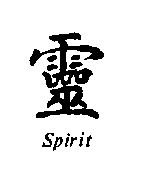
Chinese character for Spirit

The Holy Spirit

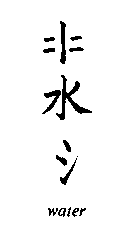
Chinese character for waterChinese character for cover

The Bible teaches that the Spirit of God “brooded” or “hovered” over the face of the waters before the creation of land (Genesis 1:2). The character for “water” is turned on its side and combined with the character for “cover” — giving the idea that the Spirit of God covered, or hovered over, the face of the waters.
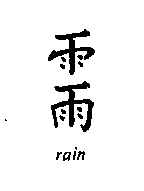
Chinese character for rain

Notice how similar this combination becomes to the word for “rain.” In Scripture, rain often pictures how God pours out His Spirit upon the earth: “…I will pour out My Spirit upon all flesh” (Joel 2:23, 28).
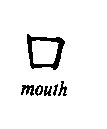
Chinese character for mouth or person

In the middle of the “Spirit” character, the character for “mouth” or “person” is repeated three times — reflecting the Trinity. When God says, “Let us make man in our image,” He speaks in a special plural denoting at least three: Father, Son, and Spirit. Even in characters 700 years older than the Hebrew of the Old Testament, the Trinity is revealed.
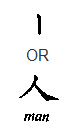
Chinese character for two forms of the character for man

Here are two forms of the character for “man.” The lower, most common form shows a short trunk and two legs; when used inside another character it is sometimes abbreviated to a single vertical line, as in the upper form.

Chinese character for work

In the character for “work,” the top line represents heaven and the bottom line earth, with a man (the abbreviated form) working in between.

Chinese character for worker of miracles

Here three persons are working — two with the normal character for person, the third the abbreviated form. They are the three “mouths” seen earlier. Combined, they mean “worker of miracles.” Indeed, when Father, Son, and Holy Spirit work together as One, miracles happen!

The components of the Spirit character

So the Holy Spirit covered the waters of the earth in creation, pours out His blessings upon Christians, is one Person of the Trinity, and is a worker of miracles — a wonderful description taken straight from the Chinese character.

Other Instances of the Trinity

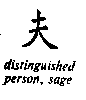
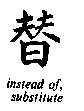
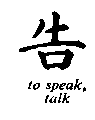
Chinese character for to speakChinese character for distinguished personChinese character for substitute

The first character means a “distinguished person”; the second, a tongue inside a mouth, means “to speak.” Combined into the character for “substitute,” they render “one speaking on behalf of two others.” In the New Testament, Jesus Christ represents the other two Persons of the Godhead.
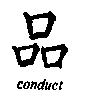
Chinese character for conduct

The character for “conduct” holds another Trinitarian idea: the ancient Chinese believed a wise word spoken by three mouths of authority was to be a rule of conduct. So God’s Word, spoken by Father, Son, and Holy Spirit, is the ultimate rule for our lives.
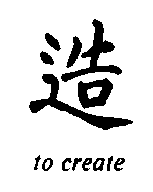
Chinese character for create

Create

The character for “create” is perhaps the most explicit recollection of the Genesis account. Let’s look at its component characters.

Chinese character for mouth or person

At its center is a pictograph of an open mouth — “mouth” or “person.”

Chinese character for dust

The “dust” character is the number “ten” over a horizontal line — “ten toes standing on the ground, mud, or clay” — giving the meaning “dust.”

Chinese character for speak

Add a mark in the upper-left indicating “breath” or “life,” and we have “that which is made of dust has a mouth and breath, and therefore speaks.”

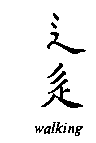
Chinese character for walking

Finally, the character for “walking” — an older pictograph showing a man’s two legs, an outstretched hand pointing the way, and three lines for hair blown back by his rapid progress.

The components of the Create character

Put together: “And the LORD God formed man of the dust of the ground, and breathed into his nostrils the breath of life; and man became a living soul” (Genesis 2:7). After God breathed into Adam, he became a full-grown, walking, talking man — and the Hebrew word for “Adam” means “ground.”

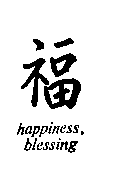
Chinese character for blessing

Blessing

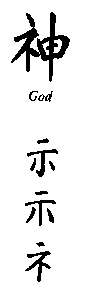
Chinese character for the God radical

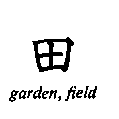
The character for “happiness” or “blessing” contains the “God radical” on the left. In the upper right is the single line meaning “one” or “first,” below it “mouth” or “person,” and below that the character for “garden.”

Chinese character for personChinese character for garden

The meaning: God + first + person + garden = blessing. Adam experienced true blessing and happiness alone in the garden with God. Even today, the greatest blessing comes from the eternal life God gives (John 17:3) and the fellowship we enjoy with Him.

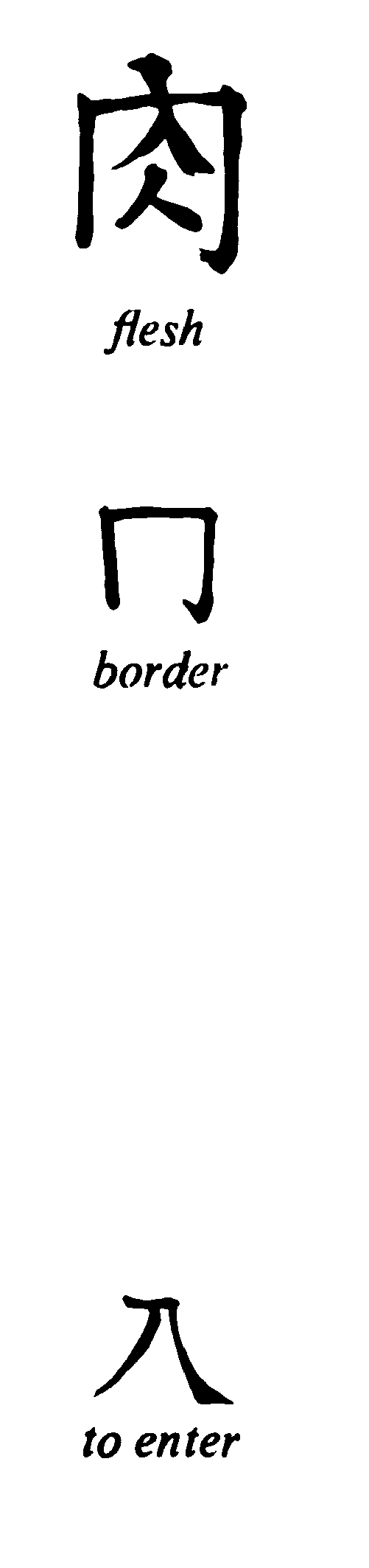
Chinese character for flesh

Flesh

Genesis 2:21–25 tells us God caused a deep sleep to fall on Adam, removed one of his ribs, and from it made woman. The character “rou” for “flesh” shows a border over a man, with a break in that border containing the character “to enter,” and another “person” hidden inside the first. So God makes an entrance through man’s “border,” revealing another person inside. (A Chinese husband may still call his wife his “inside man.”) It is a beautiful picture of God reaching inside Adam to take the rib from which He made Eve — “bone of my bones, and flesh of my flesh.”

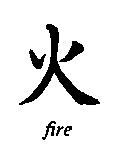
Chinese character for fire

Fire, Light & Ancestor

The character for “fire” shows the trunk and legs of a man with flames or light radiating from his body. Why? Read on.

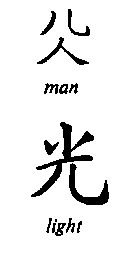
Chinese character for man and light

The word for “light” carries a similar idea. Adam and Eve lacked clothing yet felt no shame — until they sinned and became aware of their nakedness (Genesis 3:7). When Moses came from God’s presence, his face shone though he was unaware of it (Exodus 34:29). If a sinner like Moses shone, how much more would sinless Adam and Eve, walking with God, have radiated His glory? Made in God’s image (1 Corinthians 11:7; Psalm 104:1–2), they were covered with the glory of God — and lost that covering when they sinned.

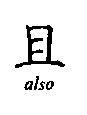
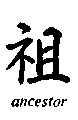
Chinese character for God radicalChinese character for also, moreoverChinese character for ancestor

Several forms of the “God” radical carry the sense of “reveal” or “manifest.” The word for “ancestor” joins the “God” radical with the word for “moreover, also” — agreeing with Genesis 1:26 that Adam, whose only ancestor was God, was made in the image of God.

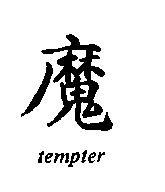
Chinese character for tempter

Devil & Tempter

The word “devil” is composed of two characters, the second contained inside the first; repeating the “devil” portion emphasizes this being’s evil nature. The component characters show astonishing detail from Genesis — in a language that predates Old Testament Hebrew by 700–1,700 years.

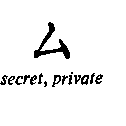
Chinese character for secret or private

First, a character meaning “secret” or “private.”

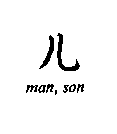
Chinese character for man or son

Then a variation on the character for “man” or “son.”

Chinese character for garden

And an enclosed garden divided into four parts.

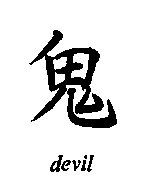
Chinese character for devil

Combined, they give the character for “devil”: crafty, tricky, and secretive. He tells Eve (and Adam, who was with her — Genesis 3:6) only what he wants, concealing the consequences, speaking with a man’s voice, in the garden of Eden.

Chinese character for tree

To form “tempter,” we top the “devil” character with two trees — for of the many trees in Eden, only two are named: the tree of life and the tree of the knowledge of good and evil (Genesis 2:9).

Chinese character for cover

We then add the character for “cover”: the temptation took place under the cover of the trees. Satan does not work in the open light, but in subtlety and craft.

The components of the tempter character

See how perfectly these characters for the tempter tell the story of Genesis 3:1–5.

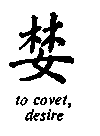
Chinese characters for covet and forbidden

Covet & Forbidden

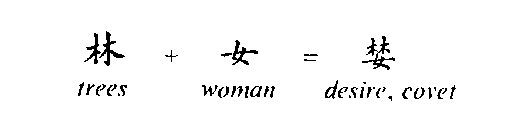
The components of the covet character

The word “covet” or “desire” pictures a woman making a decision between two trees — the two significant trees set side by side in the garden (Genesis 2:8–9), where she made the wrong choice (Genesis 3:6).

Forbidden

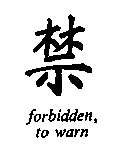
Chinese character for forbidden

“Forbidden” again shows the two trees at the top, with an abbreviated form of the word for God plus a “hook” that changes “God” to “God commands.” So “forbidden” means “God makes a commandment about two trees.” God did exactly that — first forbidding the tree of the knowledge of good and evil (Genesis 2:16–17), and after the fall, the tree of life (Genesis 3:22–24).

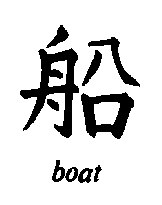
Chinese character for boat

The Ark

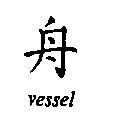
The Chinese word for “boat” testifies to the events of Genesis. It is built from three component radicals.

Chinese character for vessel or ship

The leftmost character means “ship” or “vessel.”

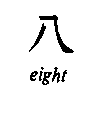
Chinese character for eight

The upper-right character is the Chinese number “eight.”

Chinese character for mouth or person

The lower-right character means “mouth” or “person.” The first boat in the Bible is Noah’s ark — and how many “mouths” were aboard? Genesis 7:13 names Noah, his wife, his three sons, and their three wives: eight people. The character records a vessel with eight people, in perfect detail.

This material draws on The Discovery of Genesis by C. H. Kang and Ethel R. Nelson, which explores how the traditional Chinese characters echo the events of Genesis.